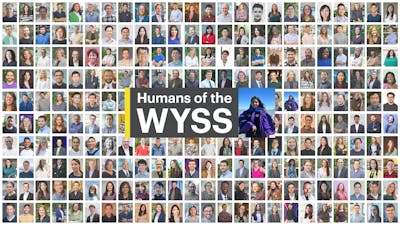
The Humans of the Wyss (HOW) series features members of the Wyss community discussing their work, the influences that shape them as professionals, and their collaborations at the Wyss Institute and beyond.

What do pottery and materials science have in common? Namrata Ramani used to think they were worlds apart. Then, as she honed her skills on the wheel and at the bench, she realized there are connections to materials science everywhere, including in the glazes she uses to make her pottery colorful. At the Wyss, she is part of the DAIRS project, determining the best way to deliver therapeutic RNA molecules to fight cancer. Learn more about Namrata and her work in this month’s Humans of the Wyss.
What are you working on?
I’m primarily working on the collaborative ARPA-H DAIRS project, where we are designing molecules that activate the immune system to fight cancer.
Our bodies are highly effective at sensing foreign pathogens and raising the alarm when something like a virus hits us. But cancer can overcome our body’s natural defenses, so the immune system isn’t able to easily recognize and fight it. Many cancers with poor prognosis are considered “immune cold,” which means they are really effective at suppressing an immune response and often don’t respond well to existing immunotherapies. In the DAIRS program, we’re trying to use therapeutic RNA to activate the innate immune response to direct the immune system towards recognizing and eradicating cancer cells.
As part of Natalie Artzi’s lab, our job is to determine how to deliver the therapeutic RNA molecule to the intended cells to achieve maximal response. If you were to inject RNA directly into your body, it would rapidly degrade and wouldn’t reach the tissue and cellular targets. We’re engineering nanoparticles to stabilize the RNA and traffic it to specific parts of the body. Our group has also learned that the structure of these particles is as critical as the molecules that they are delivering. The chemical identity and structure of the nanoparticles we design affect the context in which immune cells process the RNA cargo, which affects the downstream immune response. We call this strategy structural nanomedicine.
What real-world problem does this solve?

Every cancer is unique. Right now, we’re working with melanoma models. We are motivated that this class of molecules, which we call immune activators, could become a generalizable therapy to fight multiple types of cancer and even other types of diseases, including infectious diseases and autoimmune disorders.
In the case of cancer, you often need a toolkit of therapies to effectively eradicate it. We envision our therapy being part of a combination of treatments, which might include chemotherapy to damage the tumor, radiation, and our treatment to help kickstart the immune response and build immune memory.
What inspired you to get into this field?
I grew up in California, specifically in Silicon Valley, in a town called Cupertino, where Apple’s headquarters is located. Although STEM was ever-present, I didn’t have a clear idea of what I wanted to do in life. In my own form of subtle rebellion, I decided to pick the weirdest-sounding engineering major, which was materials science. This allowed me to explore many fields, including biology, chemistry, and physics. I could build anything from tiles for a space shuttle to biomaterials for therapeutics to solar cells to running shoes.
One of my courses in college was focused on biomaterials. We had to work in teams to develop a design proposal. We designed a little implantable capsule to deliver medications to patients who were experiencing depression and not adhering to treatments due to various challenges. I realized that we could use biomaterials to have a positive impact and make people’s lives easier. When I got involved in undergraduate research, I really enjoyed the hands-on and creative aspect of materials science.
It’s such a privilege to do something I love every day. I feel so lucky to have found that with materials science.
It’s such a privilege to do something I love every day. I believe that anyone can do what all of us do, but it’s a matter of finding something you connect with. It can be difficult to figure out what you’re most interested in, and not everyone has the same opportunity to explore. I feel so lucky to have found that with materials science.
What continues to motivate you?

My peers. Sometimes when you are in the weeds of science, you lose sight of that bigger picture. What motivates me is being surrounded by fun, smart, stimulating people who constantly surprise me with their ideas and their visions.
What excites you the most about your work?
For the first time in my academic journey, I feel like I’m doing true teamwork. We are all putting our heads together to solve a problem, and everyone is equally engaged and cares about moving this project forward. I think that’s really unique to the Wyss, and I love being part of this team.
What are some of the challenges that you face?
It’s difficult to deal with failure. For example, I just spent two weeks working on an experiment that went into preclinical models, and after all the preparation, lab work, and data analysis, I realized it didn’t work. During those challenging times, I step back and ask, what can I learn from this? What went wrong and why? If I can take something from the experience, then it wasn’t a complete waste. I think this mindset has helped me even beyond work. Life is unpredictable, so having that resilience is valuable, even if it can’t fully erase the disappointments on the roller coaster of research and life.
Why did you want to work at the Wyss?

In undergrad, I took a cool research-based class where we had a mini journal club once a week. When it was my turn to present, I found this paper from Jennifer Lewis’ lab. They printed hydrogel flowers and used the abilities of the hydrogels to swell and different solvent conditions to control how the flowers opened and closed. The method was called 4D printing. I thought it was amazing how they described drawing inspiration from Nature to create their design, and I loved the idea of using lessons from the world around us to think about engineering. I wondered, where do they do work like this? That’s when I discovered the Wyss. It’s hard to believe that ten years later, I am actually here.
What is unique about the Wyss? How has that impacted your work?
Before coming to the Wyss, I hadn’t really thought about what it means to make something work in the real world. In school, you’re focused on meeting deadlines for classes. Then, when I got to graduate school, there was a lot of freedom to try risky things and fail, but the end goal was to publish a paper. Here, we’re thinking beyond that and considering what it takes to reach the clinic, including steps such as regulatory approval that I hadn’t previously considered. It’s helped me think differently about my work.
Before coming to the Wyss, I hadn’t really thought about what it means to make something work in the real world. Here, we’re thinking beyond publications and considering what it takes to reach the clinic, including steps such as regulatory approval.

We’re also surrounded by people with industry experience who can teach us. For example, my colleague Zohar Pode helped lead a cancer immunotherapy through Phase I FDA clinical trials. Also, I recently spoke with a new member of the Advanced Technology Team, Dana Vuzman, who shared her professional journey directing a genomic medicine platform at Brigham and Women’s Hospital. In school, you don’t have as many opportunities to meet people with different career paths. I’m still learning, so it’s great to tap into these diverse experiences. The professors at the Wyss are open to learning from people with varied backgrounds, recognizing that their perspectives are valuable to advancing the work. That’s been really cool to witness.
How do you collaborate with teams across the Wyss Institute?
I’ve never been at a place where collaboration was so easy. The fact that we have shared lab and office spaces makes it so easy to walk around and find the people you need to talk to. With the DAIRS project, we’re good about meeting regularly and communicating frequently. We always consult each other before deciding which direction to take. There is room to try new things, but we can always reach out for help, guidance, or another perspective.
How have your previous work or personal experiences shaped your approach to your work today?
During graduate school, I learned a great deal about staying motivated, creating my own structure, learning, and working with others. It’s called a Doctor of Philosophy for a reason; it gives you the opportunity to learn about your personal ethos. I found that what I love about academia is the ability to work with other people and teach them how to realize their full potential. It’s so cool to witness that moment when someone has an epiphany, overcomes a hurdle, or discovers something. I am excited to pay forward what my mentors gave me and help younger students.
What do you like to do outside of work?
Right now, my main obsession is pottery. I started in graduate school, and I am by no means a professional, but it’s meditative to spend three hours where it’s just me, the wheel, and the clay. It’s very physical and creative. I love that you can take the same ball of clay to the wheel and come up with something completely different.
When I started, I thought I was looking for something opposite to science, but the more I do pottery, the more I see the science in it. For example, the glazes we use are called reactive glazes. They contain metal oxide particles that undergo chemical transformations at different temperatures to create all of the beautiful colors we see. It’s neat to see where these worlds collide.
What’s something fun or unique about you that someone wouldn’t know from your resume?
I grew up as a “third culture kid.” I have had to blend my Indian roots with my American upbringing, so I’ve grown up embracing both cultures. That experience made me really interested in learning about other cultures. I’ve been lucky to travel, and I hope to continue doing that. I studied abroad in Japan in college, which was a very formative experience. I also did a research experience for undergraduates funded by the National Science Foundation in Sweden. Travel allows me to experience different ways of life and to observe how people across the world can be unexpectedly similar. I love how international the community at the Wyss is. I have colleagues from Mexico, Israel, Korea, China, and more, so on any given day, you’re hearing different languages or tasting different foods.

1/8 Namrata grew up as a "third culture kid," which inspired her love of travel. Here, she poses in India, the country her family is from. Credit: Namrata Ramani 
2/8 Namrata got to study abroad in Japan. While there, she visited this cat cafe. Credit: Namrata Ramani 
3/8 Namrata had the opportunity to do research over the summer in Gothenburg, Sweden. Credit: Namrata Ramani 
4/8 Namrata enjoys traveling and learning about different cultures. Here, she is waiting for the train to Chiang Mai, Thailand with her best friend during a backpacking trip. Credit: Namrata Ramani 
5/8 Namrata got to meet elephants on her trip to Thailand. Credit: Namrata Ramani 
6/8 Namrata and her father at Mt. Fuji in Japan. Credit: Namrata Ramani 
7/8 Namrata and her mom took a quick selfie while enjoying their time in South Africa. Credit: Namrata Ramani 
8/8 Namrata loves to travel, and enjoyed her trip to Thailand. Credit: Namrata Ramani

If you had to choose an entirely different career path, what would it be?
I have two answers. If I had decided not to pick materials science, I probably would have wanted to be a psychologist or a psychiatrist. I love learning about the human condition and understanding what people have to work through, and the ups, downs, and challenges that life brings.
Along with travel, I love tasting different coffee brewing methods from around the world, like Ethiopian buna coffee. In South India, where my family is from, we have something called filter coffee. You put coffee powder in a steel filter, and it creates a coffee condensate. You typically add milk and/or sugar. It’s sweet, rich, and comforting. It’s cool that the same bean can be used in so many ways. Sometimes I dream of opening a coffee shop that serves styles from around the globe.
What does it feel like to be working on cutting-edge technology that has the potential to have a real and significant impact on people’s lives and society?
Having that end goal in mind of helping patients by curing diseases, diagnosing new diseases, or just making the way we move through life a little bit easier motivates me every day.
It’s really gratifying. When you’re in the throes of it, you can sometimes lose sight of why you’re doing the work. But having that end goal in mind of helping patients by curing diseases, diagnosing new diseases, or just making the way we move through life a little bit easier motivates me every day. The idea that you design not just for the sake of designing, but have a purpose, is really special.