The Problem
The COVID-19 pandemic has made it starkly clear that the world lacks rapid, accurate diagnostic tests for pathogens. When patients arrive in a medical facility for treatment, the triage process is hindered by diagnostic tests that are inaccurate or take a long time to produce results. In addition, patients who are asymptomatic and do not know they are sick might never get tested, and can infect many others.
Wyss Solution

A research team at the Wyss Institute has integrated its freeze-dried cell-free biological reactions and synthetic biology circuits into fabric to create wearable freeze-dried cell-free (wFDCF) technology. wFDCF combines a lateral flow assay (the same technology used in at-home pregnancy tests) with nucleic acid sensors developed at the Wyss Institute to create a low-cost diagnostic that clearly reports a positive or negative result using a pattern of lines on a paper strip.
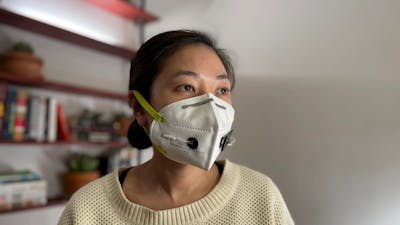
wFDCF can be embedded into any face mask and is able to rapidly and accurately detect the presence of SARS-CoV-2 viral RNA in a patient’s breath. The diagnostic is activated via the push of a button that releases a small amount of water into the sensor to initiate the biological reaction. Results are available within 90 minutes at levels of accuracy comparable to standard nucleic acid-based diagnostic tests like PCR.
We have essentially shrunk an entire diagnostic laboratory down into a small, synthetic biology-based sensor that works with any face mask, and combines the high accuracy of PCR tests with the speed and low cost of antigen tests.
wFDCF can be integrated into clothing and customized to detect a wide array of environmental threats. Additional use cases include medical professionals working with pathogens, military personnel with potential exposure to bioweapons, and environment clean-up efforts involving toxins.
