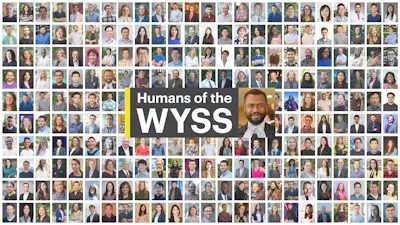
The Humans of the Wyss (HOW) series features members of the Wyss community discussing their work, the influences that shape them as professionals, and their collaborations at the Wyss Institute and beyond.
How is developing therapeutics like writing a song? Ernest Aguinam starts with a hypothesis or a new lyric, tests variables, like tempo or a new compound, and in the end, aims for a certain impact. In the case of a song, it might be invoking an emotion in the listener. In research, it is treating a disease. At the Wyss, Ernest is using Lymph Node Organ Chips to study the immune system and ultimately develop medical countermeasures for radiation injury and chronic Lyme disease. Learn more about Ernest and his work in this month’s Humans of the Wyss.
What are you working on?

I am using the Lymph Node Organ Chip to study the immune system in a number of different contexts. I’m mostly focused on two different projects: one looks at radiation and the other at Lyme disease.
The first project is part of a large Biomedical Advanced Research and Development Authority (BARDA) grant to better understand the illnesses and injuries that result from high doses of radiation, and to predict and evaluate potential treatments. Specifically, my task is to understand how radiation injury affects the human immune system and how that can impact the effectiveness of vaccines you’ve received or your immune system’s ability to respond to future vaccines. From there, the goal is to identify drugs that can reverse that radiation injury.
The other project studies chronic Lyme disease, a debilitating infection caused by Borrelia and spread by deer ticks. Acute Lyme disease is the initial infection, where symptoms can resemble a common cold, like headache and weakness. At that point, it targets the immune system. But in some cases, the bacteria aren’t cleared from the system and stay long enough to reach deeper tissues and hide from the immune system. This typically occurs when it’s left untreated, or in some cases, after treatment, someone develops Post-Treatment Lyme Disease. That’s when it becomes chronic.
First, we want to understand how the bacteria avoid clearance by the immune system and persist long enough to cause chronic disease. Second, we want to develop medical countermeasures that can resolve the persistent infection.
What real-world problem does your work solve?

There are many reasons someone might be exposed to radiation. There are occupational hazards and clinical exposures, like cancer therapy. Astronauts are exposed in deep space, and soldiers might be exposed on the battlefield. There could also be nuclear disasters. Improved understanding and treatments would better prepare us for future disasters and could help cancer patients reduce treatment side effects. Understanding the impact of radiation on vaccine response could help protect vulnerable populations in the event of another pandemic.
Lyme disease is a big problem, especially in New England and the Northeast, where it’s more common than in other parts of the United States. Symptoms include brain fog and other neurological problems, chronic fatigue, heart problems, and chronic arthritis. For chronic Lyme patients, antibiotics may not solve the problem because there are immunological components to the disease at that point. We are working to validate an immunotherapeutic candidate, and hopefully we can eventually have a treatment for these patients.
What inspired you to get into this field?
I started my career as a veterinarian in my home country of Nigeria. While treating the animals, I was always enthusiastic about understanding the immunological basis of specific diseases or treatment outcomes. If I administered a vaccine or an animal had an infection, I wondered how the body was responding. That was the question I kept asking as I ran my clinic. So, I decided to leave my veterinary practice and pursue a master’s and Ph.D. in the field of immunology.
What continues to motivate you?
There are many open questions about how the immune system responds to infections or environmental factors. I’m always thinking about the challenges of having safe and effective vaccines and therapeutics both from a host immunology perspective and from a product or vaccinology angle. These are some of the thoughts and questions that keep me going. I am also motivated by the sheer desire to know and find things out. If there is an open scientific question about my work, I like to get to the bottom of it.
What excites you most about your work?
Sometimes, if I’m feeling down, I’ll think of an unanswered question related to something I’m working on, and it gives me the strength to get up and keep working.
There are still missing pieces of the puzzle to identify. Sometimes, if I’m feeling down, I’ll think of an unanswered question related to something I’m working on, and it gives me the strength to get up and keep working. I’m also excited by the idea that I can potentially make an impact on patients who are suffering and improve their lives.
What are some of the challenges that you face?

I’d say one of the most challenging parts of my work is staying organized across multiple projects and interests, but I have great support from the research assistants on my team and good mentorship from my supervisors. I also had some culture shock coming from the United Kingdom, where I did my Ph.D., because the work style and work ethic are different in the United States. But it’s been over a year, so I am better adjusted.
Why did you want to work at the Wyss?
While I was applying for postdoctoral positions, the Wyss Institute stood out to me because it represents the best of both worlds. It’s embedded in an academic system, but also has an industry mindset. There aren’t many institutions like that. You have this blend of academic freedom, where new ideas are welcome and supported, along with the clear direction of industry, with defined deliverables and deadlines. A purely academic setting might not immediately translate to products that can have a positive impact, and a purely industrial setting might not give you the opportunity to explore your intellectual curiosity.
[At the Wyss] you have this blend of academic freedom, where new ideas are welcome and supported, along with the clear direction of industry, with defined deliverables and deadlines.
How has the Wyss’ unique environment impacted your work?
It has helped me to work backward from a vision of the endpoint. For example, we know our goal is to have a clear therapeutic on the market, and then we can steer the project to serve that objective. I put more time into things that will help us achieve that, and less time into things that are also interesting, but could be distracting.
How do you collaborate with others across the Wyss Institute?

Don Ingber’s lab is very large, and it includes researchers and scientists from many different fields, so there’s a lot of collaboration. Across all my projects, my mentors support me, and in turn, I work with other junior scientists. We communicate well and meet regularly.
Something I really like about the Wyss is that people can reach out when they think you have the right expertise and get your ideas on a project, even if you’re not part of their team. You can give your input and move on to other things, and then they might call you back to evaluate how it went. It’s a really collaborative environment.
How have your previous work and personal experiences shaped your approach to your work today?
Curiosity has been the central thread running through my career. That’s what led me to leave the veterinary practice and apply my expertise and inquisitiveness to broader goals. It was evident during my Ph.D., where I was fortunate to have a supportive lab and supervisor who enabled me to pursue my ideas. So, I think that’s what I bring to the Wyss, and it helps me to continue asking questions and trying new ideas.
Curiosity has been the central thread running through my career. That’s what led me to leave the veterinary practice and apply my expertise and inquisitiveness to broader goals.
When you’re not at the Wyss, how do you like to spend your time?
I enjoy going on evening walks with my wife and kids and playing board games like chess. I spend time talking to my family back home. I have a very large extended family, so it takes some time to get to everyone. I also like to visit friends locally and to go on short weekend trips with my family. I like to sing and enjoy good music. I read self-improvement books, listen to podcasts, and watch reality shows and movies based on true events. I also enjoy spending time with my wife, who has always been very supportive of me.
What is something fun or unique about you that someone wouldn’t know from your resume?
I’m a singer. I used to compose choral music and have led multiple church-based singing groups, mostly in Nigeria and, to a lesser extent, in the U.K. I sing mostly choral and classical music, but I enjoy all good harmonic music. When I was younger, around five years old, I remember my parents debating whether I would grow up to be a musician. Lately, I haven’t had much time to explore my musical side, but I have been to orchestras in Boston like the Boston Symphony Orchestra and have gone to some evening live-band shows with some of my Wyss colleagues.
If you had to choose an entirely different career path, what would it be?
In a way, this is already my second career after being a veterinarian, but what comes to mind is pursuing music more seriously or officially. But whatever it is, it has to be something that gives me the opportunity to be creative or keeps me thinking. If I were in a routine job, I would get bored. Research certainly isn’t boring.
What does it feel like to be working on cutting-edge technology that has the potential to have a real and significant impact on people’s lives and society?
It feels great! The Wyss provides the people who can help you achieve your goals and the technologies to turn your curiosity into a product that can make an impact. I aim to help cure diseases and illnesses through my work. The most fulfilling part is knowing you are working on something that could improve someone’s life. It’s amazing to be here doing that.